


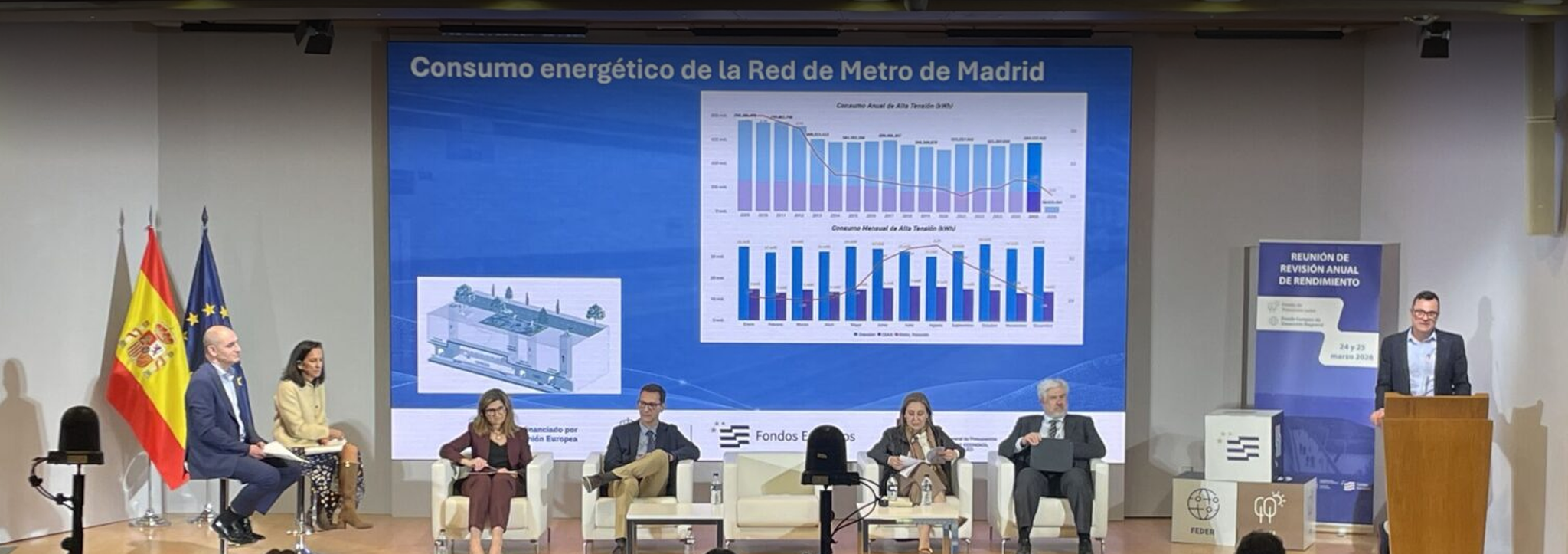
When efficiency no longer depends solely on infrastructure, but on data
Talking about energy efficiency in critical infrastructures such as Metro de Madrid is not a matter of marginal optimization. It means operating a system whose electricity consumption is equivalent to that of 170,000 households and whose energy behaviour is shaped by multiple operational, environmental and demand variables.
From reactive management to operational prediction
In this context, the MAPE project (Analytical Energy Prediction Module) introduces a shift in approach: moving from reactive management to predictive energy consumption management.
AXPE Consulting, in a UTE with our colleagues at QUANT AI Lab, has developed the analytical and predictive modules that make it possible to anticipate the energy behaviour of the system and optimise efficiency in real time. The focus has not been on experimentation, but on building robust models capable of integrating into a critical infrastructure and operating with real data.
Models that don’t just predict, but operate
The technical challenge is significant. The system must interpret large volumes of data from different sources — railway operations, thermal conditions, energy demand — and transform them into actionable predictions. This means designing models that are not only accurate, but also stable, scalable and operational within the system.
This is where applied artificial intelligence stops being an abstract concept. The developed models allow the system to anticipate consumption patterns, detect inefficiencies and adjust before significant deviations occur. It is not just about knowing what has happened, but about intervening on what is going to happen.
The project also incorporates a particularly relevant dimension: the thermal behaviour of Metro de Madrid. Tunnels and stations act as a large thermal generator, with more than 350 GWh transferred annually. Integrating this variable into the models not only improves energy efficiency, but opens the door to strategies for residual heat recovery and its impact on the urban environment.
From analytics to real decision-making
The joint contribution of AXPE Consulting and QUANT AI Lab sits at a critical point: turning advanced analytics into real operational capability. Building models is not enough; those models must work within the system, interact with operations and generate data-driven decisions.
MAPE is an example of how artificial intelligence in energy is beginning to take hold in environments where the margin for error is minimal and the impact is immediate. Here, innovation is not measured in prototypes, but in energy optimisation, operational efficiency and anticipation capability.
AI integrated into critical infrastructures
These kinds of developments draw a clear line: intelligent infrastructure management is evolving towards systems capable of understanding their own behaviour and continuously optimising it. And in that process, the combination of advanced analytics, artificial intelligence and sector knowledge is what truly makes the difference.
At AXPE, we continue to bring advanced analytics and artificial intelligence to environments where they genuinely generate impact.