


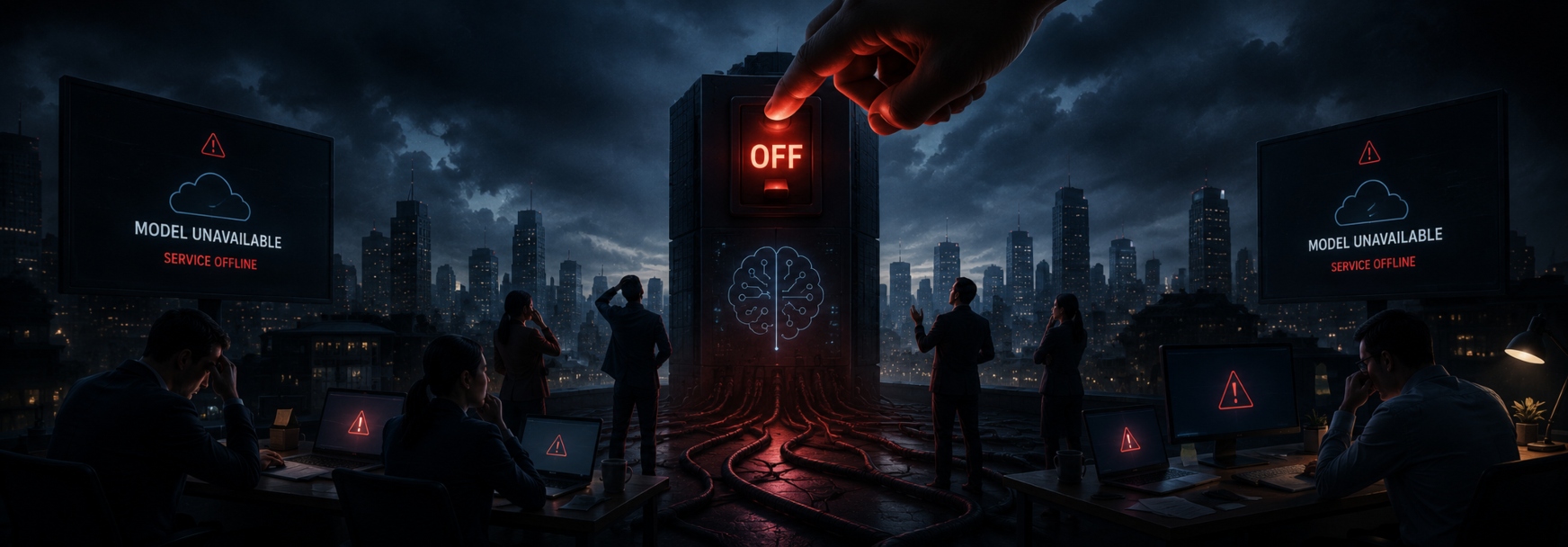
The day an AI model was turned offf (and why AXPE was ready)
What the Fable 5 ban teaches us about building with AI: how to avoid depending on any single model
This week, an artificial intelligence model that we had been using in production for days became unavailable overnight. Not because of a technical glitch, nor due to a price change: because of a U.S. national security decision that forced its manufacturer to cut off access outside its country, ultimately leaving it inaccessible to the entire world. A commercial product, publicly launched just a few days prior, shut down by order of a government that is not our own.
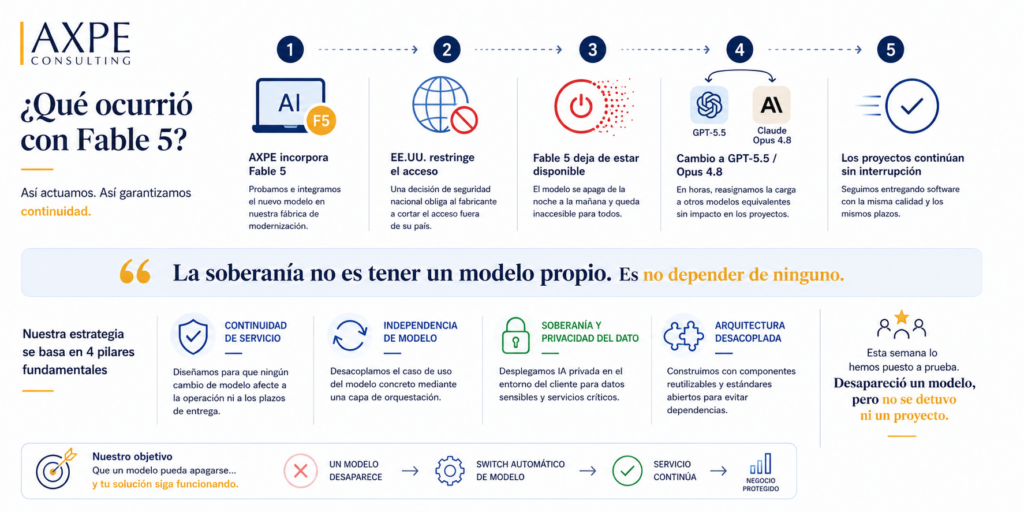
We are sharing this because it hit close to home, and that is precisely why we want to explain how we experienced it. At AXPE, we had incorporated this model —Claude Fable 5— into the suite of models available to our developers for our ongoing legacy technology migration projects. When we had to withdraw it this week, we switched back to Claude Opus 4.8 and GPT-5.5, and kept delivering software exactly the same way, without a single day of downtime. The reality is that Opus 4.8 and GPT-5.5 give us more than enough capability for what we need. An episode that would have been a crisis for many organizations was just a configuration change for us.
That difference —between a crisis and a configuration change— is what this article is all about. And it is the most important lesson that the Fable 5 case leaves for any CEO or CIO who is putting AI at the core of their business.
AI is already strategic. What is changing is who controls access to it.
Over the last two years, the AI conversation within large corporate accounts and public administrations has almost always been the same: what use cases, what savings, what productivity, which model wins in a particular benchmark. Product-centric conversations. This week’s blackout introduces a variable that almost no one was factoring into the equation: model access continuity as a vendor risk.
Access to frontier AI no longer depends solely on the commercial contract between your company and a vendor. It ultimately depends on the politics of the country where that vendor is headquartered. If tomorrow your document analysis engine, your development copilot, or your case management system relies on a single model, hosted by a single vendor, in a single jurisdiction, you have the exact same risk profile as when your entire business depended on a single data center without a disaster recovery plan. For a financial institution subject to DORA, or for an agency providing an essential service under the ENS, this is no longer a philosophical debate: it is an operational risk that will now appear in audits.
The good news is that there is a solution, and it is not what the background noise suggests.
Sovereignty is not about having your own model. It is about not depending on any.
The instinctive reaction to the blackout is to lament that Europe does not have its own frontier model and to demand one. That is a legitimate aspiration as a country, but it is the wrong answer for an organization that needs to operate in 2026, not 2030. No one is going to build a competitor to the American or Chinese tech giants from their IT department, and while waiting for someone to do so, exposure remains.
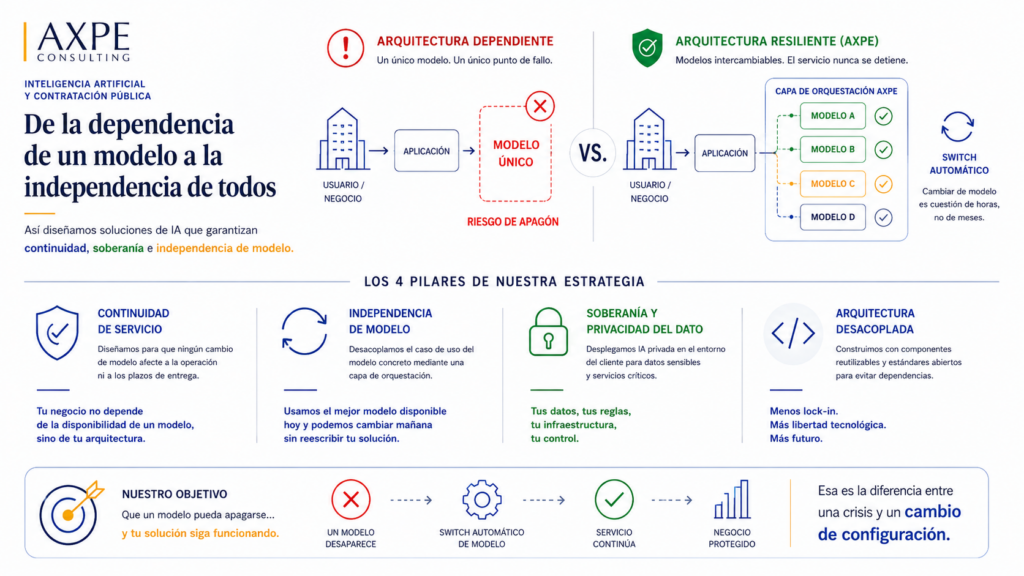
The sovereignty that is actually within reach for a Spanish organization today does not consist of owning a model, but of not depending on any single one in particular. And that is an architectural decision, not a geopolitical one. It means designing AI systems where the model is treated as what it truly is—a replaceable component—sitting behind a layer that decouples the use case from the specific model running it. Done this way, switching vendors is a matter of hours. It is, literally, what we did this week.
This is our core conviction at AXPE, and we apply it across the two areas where AI is truly transforming our clients’ businesses: in how we build software and in how we deploy AI on top of their data.
How we build it: AI writes the software, human judgment remains in control
We have been operating an industrialized legacy modernization factory for months, where AI does the heavy lifting. Critical systems written thirty or forty years ago in Natural, COBOL, or Oracle Forms […] are now migrated to a modern Java framework in about twelve months, with proven end-to-end functional parity. This is not a PowerPoint promise: there are backends and mobile applications already in production, written entirely with AI under the supervision of architects.
And here is the key that connects back to Fable 5: the value is not in the model, it is in the orchestration. What truly sets AXPE apart is not the model of the moment—which we swap whenever necessary—but the factory surrounding it: migration agents, corporate integration libraries, and, above all, our human-led methodology. That is why removing Fable and switching back to Opus 4.8 or GPT-5.5 cost us nothing: the factory is ours, the models are interchangeable.
How we deploy it: Sovereign and private AI, within the client’s perimeter
The second area involves sensitive use cases. The answer is not to connect to a commercial LLM in someone else’s cloud, but to deploy specialized, efficient models within the client’s own infrastructure—on-premise, in their private cloud, or in a sovereign cloud—with explainability and traceability designed from day one for the AI Act.
A model running within your own perimeter cannot be turned off by anyone, because it is already in your house. That is the most concrete form of technological sovereignty, reinforced by alliances with European AI technology and sovereign cloud providers in Spain. An end-to-end European stack, free from dependencies on hyperscalers or commercial models for what truly matters.
What this means for public procurement
There is a takeaway that the public sector should not ignore. A procurement tender that awards an AI service without requiring model independence, reversibility, and a contingency plan is poorly designed as of today. Procurement bodies that begin demanding these guarantees will be protecting the continuity of public services with the same criteria they have used for years when requiring exit plans in outsourcing contracts.
AXPE’s Position
The dilemma—how to adopt AI quickly without becoming locked into a vendor—has a solution: there is no need to choose between moving fast and staying protected. The competitive advantage is not about guessing which model will win the race; it is about building in a way that makes you independent of the answer.
We have spent more than twenty years working on critical systems for public administrations and large corporate accounts in Spain. Our approach is rooted in engineering: model independence from day one, AI applied to the full software lifecycle, and sovereign deployment for data that cannot leave the perimeter.
If AI is already a relevant piece of your systems plan, the question for the next committee meeting is not “which model do we use?”, but “what happens the day we can no longer use it?”. We already have the answer, and this week we put it to the test. If you are interested in benchmarking it against a real case, we are at your disposal.