



El core that had remained untouched for 30 years is starting to move
Why generative AI is not just another technological trend, but the first real shift in the economic equation of core business modernization.
Over the past three decades, I have seen the same conversation repeated in executive committees of public sector organizations, banks, insurers, telcos, and utilities: “the core needs to be modernized, but it’s not the right time”. And to a large extent, that was true. It wasn’t the right time because the numbers didn’t add up. Generative AI is the first thing in thirty years that forces a reassessment of that statement.
This article is not about technology. It is about why a decision that had been shelved for a generation is starting to make economic sense in 2026, what risks lie behind the optimistic narrative, and what a CIO or a public sector Director General should be doing today in response to this shift.
The diagnosis we all know
The large critical systems of the Spanish public administration and major private corporations — core banking, tax management, public accounting, population registers, payroll, telco billing, energy dispatch, insurance settlement — were built between the 1980s and 1990s on host environments. COBOL on z/OS, Natural/Adabas, Oracle Forms/Reports, PL/1, RPG on AS/400. Millions of lines of code that still process the country’s money, taxes, payrolls, and essential services. On top of these systems, a second and third layer have been built. First, early-generation Java EE applications. Then Spring, REST services, microservices, modern front-end technologies (Angular, React), portals, and mobile apps. The result: a hybrid architecture — to put it mildly — where the user experience is contemporary, but the critical business rules still live where they always have. The glue between these layers is an integration ecosystem that no one actually designed as such: MQ, nightly batches, flat files, CICS gateways, 3270 screen scraping, wrapper APIs built at different times by different vendors under different standards. What appears as “integration” in architecture diagrams, in day-to-day operations looks more like a fragile ecosystem sustained by two or three key individuals who, incidentally, are close to retirement.Why this has not been solved before
It is not a technical problem. It is an economic decision that has been reaffirmed year after year. A full migration program for a legacy core, using the techniques available up to 2023, implied three to five years of execution, a budget typically between twenty and one hundred million euros, and an ROI framed as “mid-term maintenance savings.” No executive committee easily approves a program with those characteristics: no visible new functionality, high regulatory risk (it cannot fail even for a day), critical dependence on undocumented knowledge, and the memory of failed migration programs from the past decade still fresh. The data confirms it. According to IDC, 47% of CIOs cite technical debt as the main cause of cost overruns in cloud and digital infrastructure. Gartner estimates that nearly 40% of critical infrastructure systems today carry a significant technical debt burden. And the operational cost of legacy is not minor: it is estimated that a large enterprise loses around $370 million annually due to inefficiencies derived from legacy systems. The paradox is well known: everyone knows it must be done, almost no one truly tackles it.What changes with generative AI
Generative AI does not marginally accelerate modernization. It changes the order of magnitude of the problem, and it does so in three very specific dimensions. First, understanding undocumented code. The biggest time sink in any legacy modernization program is not rewriting: it is understanding what the current code does. Documentation is partial or outdated, the original developers are gone, and functional analysts have rotated multiple times. Current language models read these programs, reconstruct their logic, identify hidden dependencies between copybooks, JCLs, and called modules, and generate equivalent functional documentation. The most cited public case — Egypt’s National Social Security Organization, with IBM watsonx Code Assistant for Z — reports a 79% reduction in the time required for a developer to understand a complex COBOL application: from 24 hours to approximately 5. That is the historical bottleneck, and it is disappearing. Second, semantic translation with preservation of business logic. We are not talking about syntactic converters like “literal COBOL to Java” — those have existed for twenty years and produce unreadable, unmaintainable code. We are talking about rewrites that preserve behavior while applying object-oriented structure, modern design principles, and separation of layers. Tools such as AWS Transform (which integrates the BluAge technology acquired by Amazon), IBM watsonx Code Assistant for Z, GitHub Copilot with specialized agents, or third-party platforms such as TSRI or Heirloom are already in production. TSRI documents a migration of the Canadian Revenue Agency (CRA) support system from COBOL/CICS to Java on AWS in six weeks. Three years ago, that same project would have been a two-year program. Third, automated generation of functional parity tests. The regulatory risk of legacy is managed through comparative testing that proves the new system produces exactly the same results as the old one given the same inputs. Generative AI significantly accelerates the production of these test cases, reducing the real — not perceived — risk of migration. Aggregate market figures are consistent with the above. Cognizant reports productivity increases of 70% and cost reductions of 30% in refactoring assisted by generative AI. Gartner predicts that by 2028 generative AI will have reduced application modernization costs by 30% compared to 2025 levels. The global legacy modernization market will grow from around $25 billion in 2025 to a projected $56 billion in 2030. Translated into executive committee language: a program that three years ago cost fifty million and took four years is now credible within a three-year plan with a significantly lower budget. And, above all, it is credible within a single budget cycle.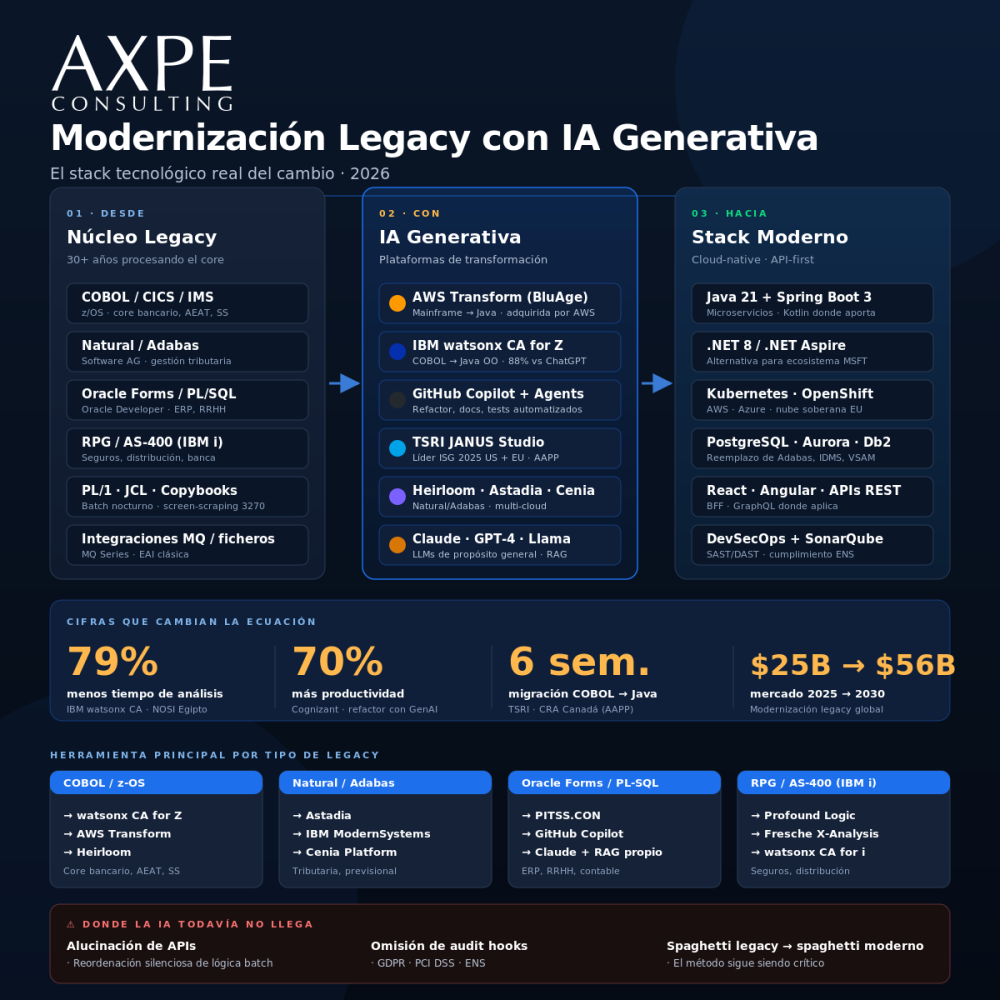
The technology stack of the shift: from legacy core to modern platforms through generative AI.