


El Gran Desacoplamiento: cómo la IA está redefiniendo la consultoría tecnológica

La inteligencia artificial rompe las reglas del juego en la consultoría tecnológica​

Las evidencias del mercado son inequívocas

El ajuste ya está en marcha en las principales firmas globales:

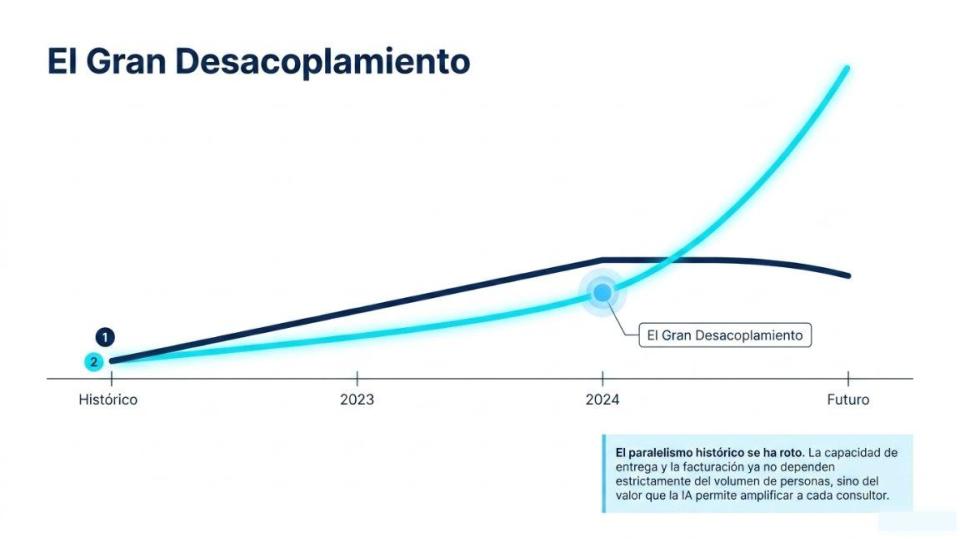
  • KPMG y Deloitte redujeron la contratación de perfiles junior entre un 18% y un 29% en 2024.
  • BCG reporta incrementos de eficiencia de hasta el 40% en nuevas incorporaciones gracias a la IA generativa.
  • Capgemini lleva a cabo reestructuraciones estratégicas en Europa automatizando tareas intermedias, incluso con márgenes de beneficio récord.

Las funciones que sostenían la base de la pirámide —desarrollo repetitivo, testing, documentación, análisis inicial— son precisamente las más expuestas a la automatización. El sector ya está ajustando sus estructuras en consecuencia.

De la pirámide al obelisco: nuevas arquitecturas organizativas

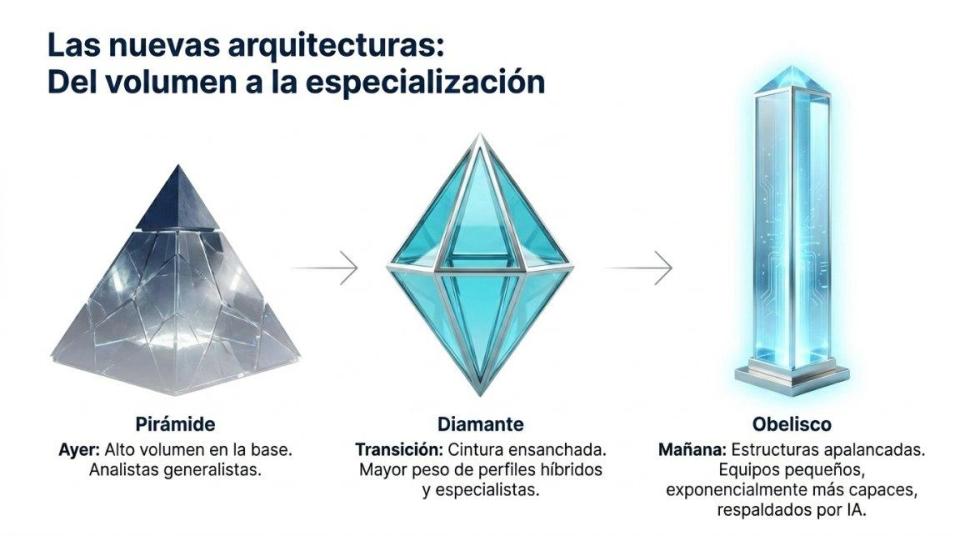
La estructura clásica de pirámide, con una amplia base de perfiles generalistas, está evolucionando hacia nuevos modelos. Primero hacia el diamante, con mayor peso de perfiles híbridos y especialistas; después hacia el obelisco: equipos pequeños, altamente cualificados y exponencialmente más capaces gracias al respaldo de la inteligencia artificial.

El volumen deja de ser una ventaja competitiva. La especialización y la capacidad de orquestar tecnología pasan a serlo.

El nuevo paradigma: Consultoría Patrimonial

El modelo de negocio ganador en este nuevo entorno es el de la Asset-Based Consulting o Consultoría Patrimonial: las consultoras líderes no alquilan tiempo, despliegan activos propios. Metodologías propietarias, Pequeños Modelos de Lenguaje (SLMs), algoritmos y agentes autónomos son el nuevo capital productivo.

El cliente ya no paga por el esfuerzo humano visible. Paga por la capacidad de aceleración, la reducción de riesgos y el resultado medible. Este giro transforma también el modelo de ingresos: de la facturación por horas y materiales a la facturación por resultados, suscripciones y licencias de activos.

El consultor del futuro: criterio humano amplificado por IA

El talento no desaparece en este nuevo modelo. Muta. El consultor del futuro es un perfil híbrido que combina conocimiento profundo de negocio —estrategia, gestión del cambio, relación con el cliente— con capacidad de orquestación tecnológica: ingeniería de IA, gobierno de datos, AI Assurance y ética.

No redacta desde cero. Orquesta agentes, reinterpreta insights y audita la calidad. El trabajo repetitivo desaparece; la necesidad de criterio se multiplica.

El mayor riesgo: la mentalidad de ayer

Integrar herramientas de IA sin transformar la estructura operativa ni el modelo de facturación es un error estratégico crítico. Competir por volumen en la era de la automatización destruye márgenes. Mantener jerarquías rígidas ralentiza la innovación. Y trasladar la eficiencia tecnológica al cliente —reduciendo horas sin ajustar tarifas— supone generar valor para otros sin capturarlo.

La diferenciación real no vendrá de “usar IA”, sino de industrializarla con criterio propio.

La visión AXPE: talento, industrialización y foco en el negocio

En AXPE Consulting entendemos que los ganadores de esta transformación serán aquellos que integren tres pilares de forma simultánea: talento experto con criterio, industrialización mediante activos de IA y agentes, y foco absoluto en los retos reales del negocio del cliente.

Crecer ya no significa contratar más. Significa multiplicar la capacidad real de producir valor. La consultoría no se reduce; evoluciona hacia su versión más inteligente, patrimonial y estratégica.

The Great Decoupling: how AI is redefining technology consulting

Artificial intelligence is breaking the rules of the game in technology consulting
The market evidence is unequivocal

The adjustment is already underway at the major global firms:

  • KPMG and Deloitte reduced junior profile hiring by between 18% and 29% in 2024.
  • BCG reports efficiency gains of up to 40% in new hires thanks to generative AI.
  • Capgemini is carrying out strategic restructuring across Europe by automating intermediate tasks, even while posting record profit margins.

The functions that sustained the base of the pyramid —repetitive development, testing, documentation, initial analysis— are precisely those most exposed to automation. The sector is already adjusting its structures accordingly.

From pyramid to obelisk: new organisational architectures

The classic pyramid structure, with a broad base of generalist profiles, is evolving towards new models. First towards the diamond, with greater weight given to hybrid and specialist profiles; then towards the obelisk: small, highly skilled teams that are exponentially more capable thanks to the backing of artificial intelligence.

Volume ceases to be a competitive advantage. Specialisation and the ability to orchestrate technology become the new ones.
The new paradigm: Asset-Based Consulting

The winning business model in this new environment is Asset-Based Consulting: leading consultancies do not rent time, they deploy proprietary assets. Proprietary methodologies, Small Language Models (SLMs), algorithms and autonomous agents are the new productive capital.

The client no longer pays for visible human effort. They pay for acceleration capacity, risk reduction and measurable results. This shift also transforms the revenue model: from billing by hours and materials to billing by results, subscriptions and asset licences.

The consultant of the future: human judgement amplified by AI

Talent does not disappear in this new model. It mutates. The consultant of the future is a hybrid profile combining deep business knowledge —strategy, change management, client relationships— with technological orchestration capability: AI engineering, data governance, AI Assurance and ethics.

They no longer draft from scratch. They orchestrate agents, reinterpret insights and audit quality. Repetitive work disappears; the need for judgement multiplies.

The greatest risk: yesterday’s mindset

Integrating AI tools without transforming the operational structure or the billing model is a critical strategic mistake. Competing on volume in the age of automation destroys margins. Maintaining rigid hierarchies slows down innovation. And passing technological efficiency on to the client —reducing hours without adjusting rates— means generating value for others without capturing it.

Real differentiation will not come from “using AI”, but from industrialising it with one’s own judgement.

The AXPE vision: talent, industrialisation and business focus

At AXPE Consulting we believe that the winners of this transformation will be those who integrate three pillars simultaneously: expert talent with sound judgement, industrialisation through AI assets and agents, and an absolute focus on the client’s real business challenges.

Growing no longer means hiring more. It means multiplying the real capacity to produce value. Consulting is not shrinking; it is evolving towards its most intelligent, asset-based and strategic form.