



AI in Public Administrations: the procurement model that is starting to fall behind
AI is changing the way software is built and maintained. Public procurement has yet to catch up. At AXPE we have been observing this underlying shift for some time — and we believe it will directly affect how IT is tendered in public administration.
What we are seeing at AXPE. We are not talking about the future. We are living it in real projects. The relationship between team size and delivery capacity is no longer linear — and that has practical implications for how public IT contracts are designed, valued and awarded.
When productivity stops being linear
Until now, across much of the sector, there was a fairly clear relationship between delivery capacity, headcount and service cost. It was not perfect, but it was predictable enough. Today that is starting to change.
Artificial intelligence makes it possible to accelerate tasks that until very recently consumed a great deal of effort: legacy system analysis, component generation, documentation, testing, maintenance support, technical oversight, code review.
This does not mean that talent stops mattering. In fact, the opposite is likely: expert talent will be more important than ever. What changes is that the real capacity of a team no longer depends solely on its size. And if that changes in delivery, sooner or later it will have to change in procurement too.
This means going beyond integration with SEPA Instant: it requires a transformation of the banking core and the technological architecture to reduce errors, improve user experience and optimise operational costs.
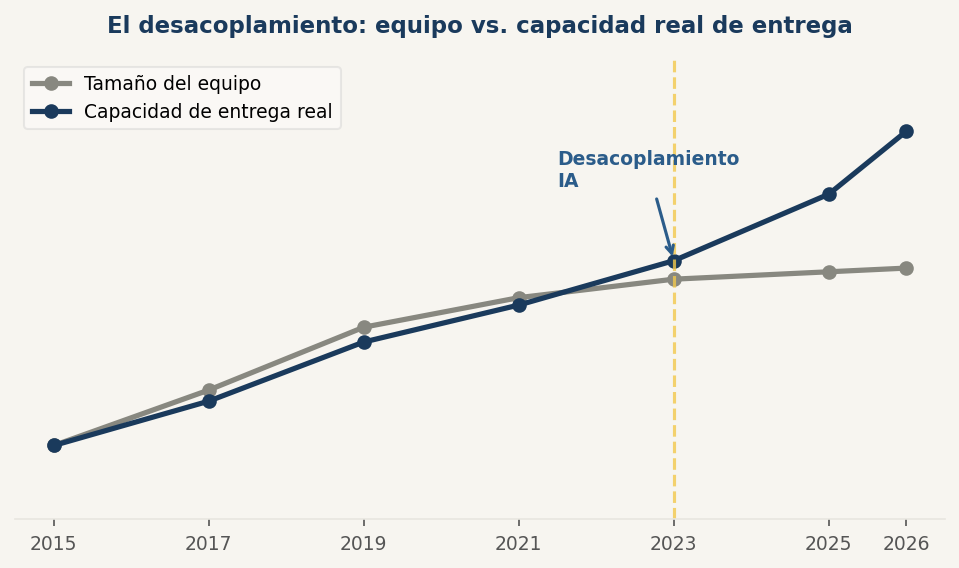
The decoupling: team size vs. real delivery capacity - AXPE analysis
An obvious risk: confusing efficiency with recklessness
At AXPE we believe that one of the most delicate points of this transition will lie in the economic interpretation of bids. If a company manages to deliver better, faster or with less effort thanks to a genuine and structured use of AI, it can submit more competitive offers.
And there lies a tension we will see more and more: what previously might have looked like an aggressive low bid may, in reality, reflect a more efficient production structure.
The dilemma: The public procurement system is not always equipped to distinguish between an unviable bid and one built on a different, more efficient operating model.
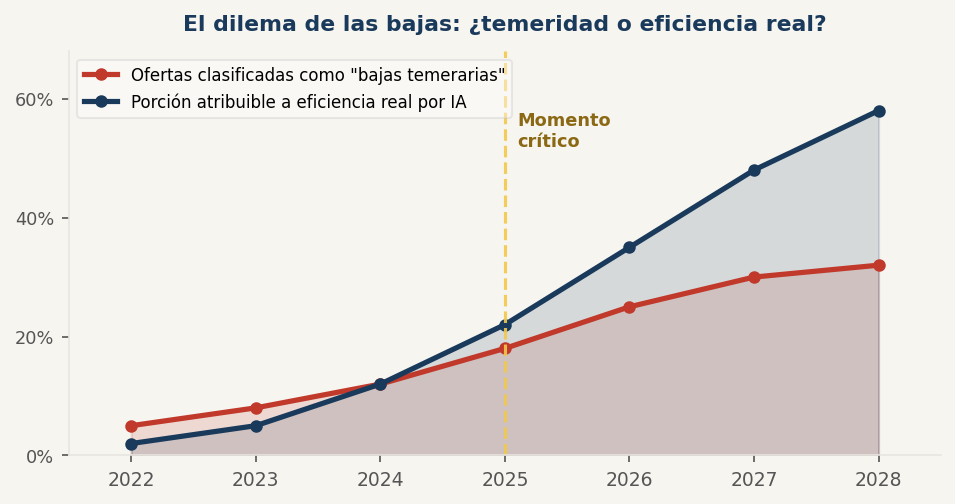
The bid dilemma: recklessness or real efficiency? - AXPE estimate
The impact will be especially visible in recurring services
Where we will notice this change first, in our view, is in the most recurring and structured services:
- Application maintenance and AMS
- Quality assurance (QA / testing)
- Technical offices and technology PMO
- Evolutionary support services
- Technical documentation and deliverable control
Why? Because these are areas where historically there has been a significant share of repetitive, traceable and structured activity — and those are precisely the layers that will undergo the most transformation.
Technical offices, for example, will need to shift away from mechanical oversight and focus more on expert control, judgement, decision-making capacity and genuine service governance.
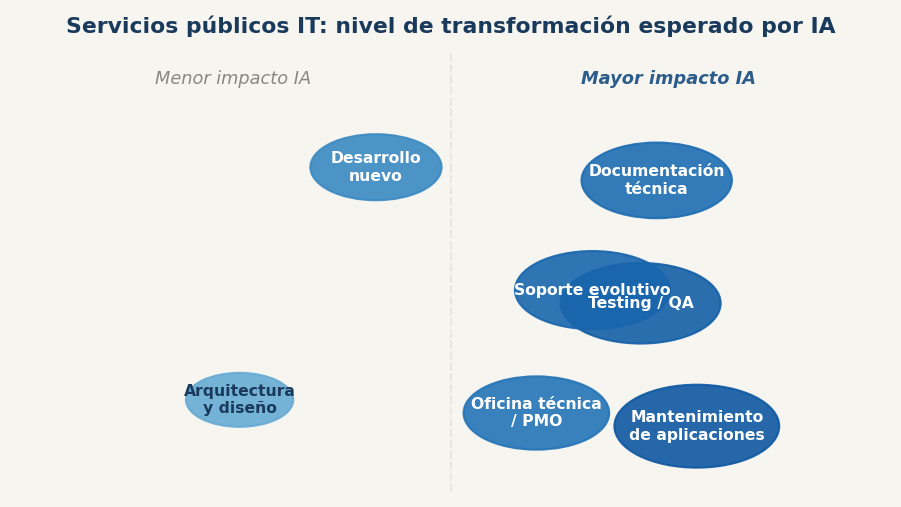
Public IT services: expected level of transformation by AI - AXPE analysis
The current framework is built on a logic that is beginning to strain
A large part of current public tender specifications still respond to an implicit premise: more or fewer people equates to more or less capacity, and cost is explained mainly by the team’s salary structure.
But if productivity stops being linear, that premise begins to break down. And when it does, many questions arise:
- How do you size a service with AI? Team size is no longer the only indicator of capacity.
- What weight should outcomes carry vs. the team? Tender specifications must incorporate real output metrics.
- How do you compare such different bids? An “expensive but efficient” offer may be better than a cheaper one without AI.
- Is the LCSP ready for this? The current framework assumes linear productivity. That is starting to fail.
At AXPE we believe this reflection is not theoretical. It is already beginning to surface in real conversations across the sector.
"The question is no longer how many people are needed. The question is what service model makes sense when productivity can change radically without any increase in team size."
The current framework is built on a logic that is beginning to strain
A large part of current public tender specifications still respond to an implicit premise: more or fewer people equates to more or less capacity, and cost is explained mainly by the team’s salary structure.
But if productivity stops being linear, that premise begins to break down. And when it does, many questions arise:
- How do you size a service with AI? Team size is no longer the only indicator of capacity.
- What weight should outcomes carry vs. the team? Tender specifications must incorporate real output metrics.
- How do you compare such different bids? An “expensive but efficient” offer may be better than a cheaper one without AI.
- Is the LCSP ready for this? The current framework assumes linear productivity. That is starting to fail.
At AXPE we believe this reflection is not theoretical. It is already beginning to surface in real conversations across the sector.
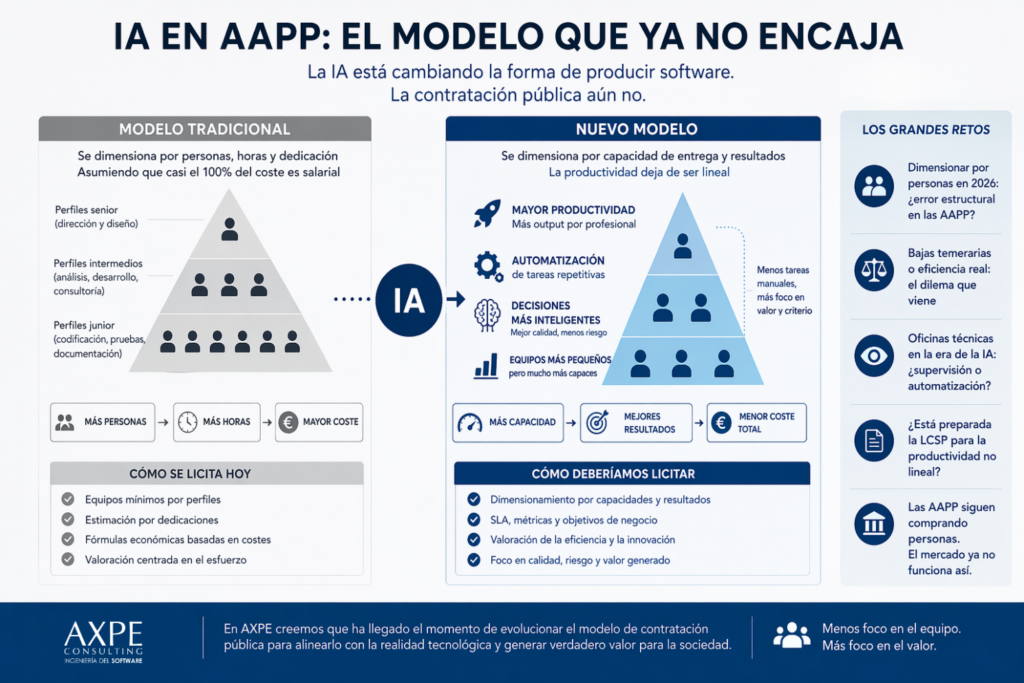
AI in public administrations: the model that no longer fits
This is where the deepest change lies. The tender specifications of the future will need to evolve:
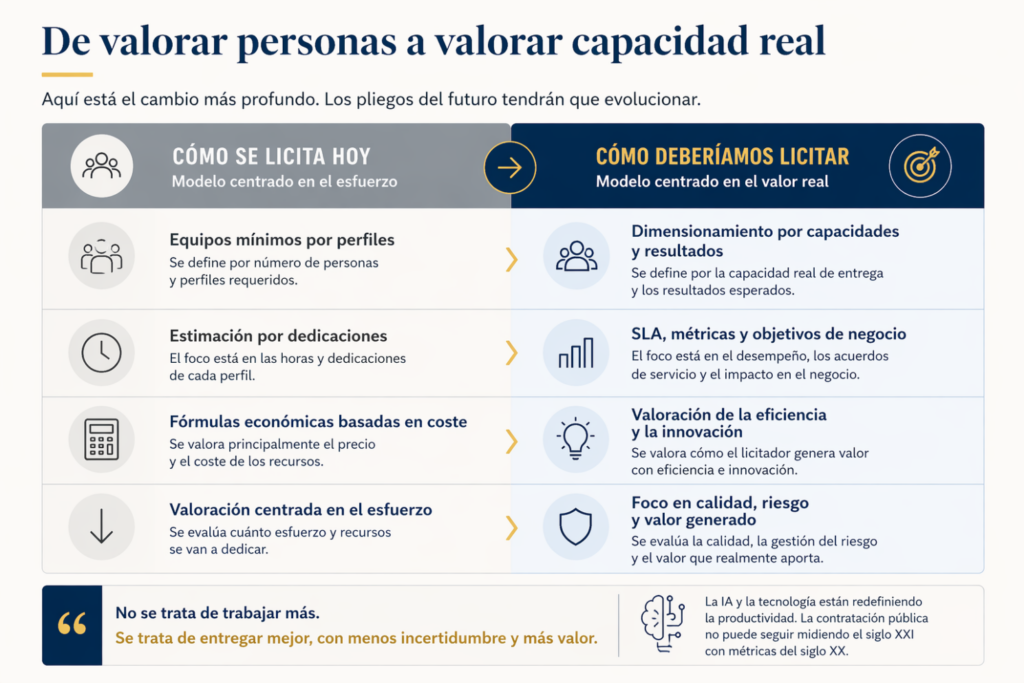
From valuing people to valuing real capacity - AXPE analysis
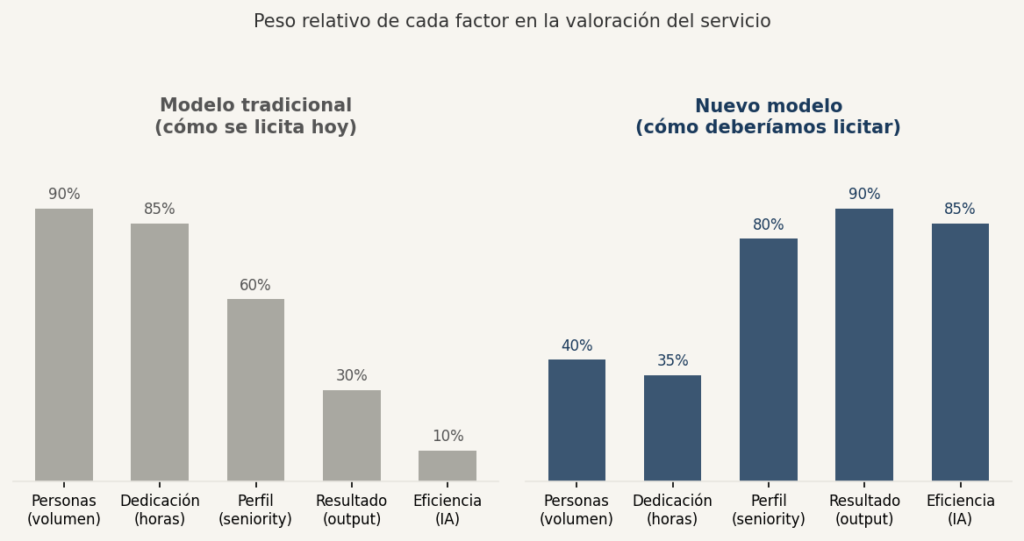
Relative weight of each factor in service evaluation - AXPE analysis
At AXPE we are preparing for that scenario
This transformation is not tackled by incorporating AI tools into day-to-day work. It is tackled by genuinely rethinking how the service is delivered, how teams are organised and how all of that translates into a reliable, traceable delivery model that is compatible with the demands of the public sector.
The future of these contracts will not depend solely on who has the most people assigned, but on who is best able to combine talent, method, automation, business knowledge and execution capacity.
For years, public software procurement has bought, directly or indirectly, people. The market is beginning to move towards a different logic: contracting for capacity, outcomes and real efficiency.
Are you debating this change in your organisation? We would love to hear your perspective.